
How To Support A Laundry Room Countertop Over A Washer And Dryer
How do you build a counter over a washer and dryer? If you're considering
building a DIY countertop or floating shelf above the washer and dryer, I have
the answers for you!
That is one of the challenging questions we faced when renovating the laundry
room. A countertop in the laundry room is a necessity. Whether you have a
small laundry room or a large one, you want to make ever inch count!

A countertop or laundry room shelf above the washing machine and dryer
provides counter space for folding clothes, a great place for placing
detergent and other cleaning products, a work surface when you're at the sink,
and - as is the case in our house - room to stack the folded clothes for weeks
until you put them away ;).
In fact, having a countertop is a priority for our laundry room makeover and
one of the reasons we didn't opt for a top load washer and dryer.
We debated a few different options for the countertop:
- a butcherblock countertop
- a melamine or laminate pre-fabricated countertop
- a pre-made countertop with edge rails
- a custom Corian, quartz, or natural stone countertop
How To Build A Counter Over A Washer And Dryer
Determining how to install a laundry countertop is not complicated and is an easy DIY project. If you are installing your own tabletop over front loaders, no matter what material you use for the countertop, the supporting structure beneath will pretty much be the same.
In fact, the method I am sharing here can be used to install any kind of
floating horizontal surface. You can use these instructions for a floating
desk, counter, or floating bench.

What's the best way to support a countertop across a washer and dryer?
Typically, laundry rooms have a counter over the top of the washer and
dryer. In order to support a laundry room countertop, you need two
components:
- Something to hold the countertop above the laundry machines, and
- Something to attach the countertop to the wall
This easy method uses a combination of cleats and gables to
achieve those two goals. The cleat provides a brace to hold the countertop
up above the machines, and the gables provides support on the side and
underneath (if needed) so the countertop won't sag.
cleat: A strip of wood or other material fastened to a wall which supports or
provides a fastening point for other items such as cabinets, shelving,
or a countertop
gable:
The rectangular boards that are used to cover the exposed sides of a
base cabinet or upper wall cabinet.
If our washer and dryer was in a niche and had walls on three sides,
depending on the weight of the countertop, we could install the
countertop using just the cleats.
In our situation, we had a longer span with sink beside the washing
machine and dryer along one wall. We used:
- a gable to support the left side of the countertop (we used a cabinet panel from the IKEA As Is section)
- a DIY gable hidden between the machines to provide additional support
- cleats on the back and right side walls.
Due to space constraints, we chose not to put a gable at the right side of
the countertop, though you can definitely do that to create a more finished
look.
Countertop Materials for the Laundry Room
The cleat and gable method can be used to support most any kind of laundry
table top including butcher block countertops, laminate countertops to
natural stone.
Now depending on countertop material you choose, the first thing you need to
determine is if you need a substrate as well.
Laundry Room Countertop Construction:
A substrate is the underlying base material (typically particleboard, MDF
(Medium Density Fiberboard), or plywood) that supports the surface material
(like laminate or stone). It provides stability, prevents warping, and gives
the countertop its necessary thickness and strength.
Consider these options:
- if you are using plywood as a countertop, you do not need a substrate. The plywood sits on the cleats and is supported by the gable as in this example.
- if you are building a wood countertop over the washer and dryer using individual maple or oak boards, you do not need a substrate. However, you will need to glue and clamp the wood boards together before installation. Similar to plywood, the boards span the width over the machines and are affixed directly to the cleats.
- if you are using a melamine or laminate materials you do not need an additional substrate. The laminate (plastic) is already fused onto a substrate (either plywood, MDF or particleboard. See here for differences about the materials.)
- if you are using wood countertops like a solid wood butcher block countertop or wood veneer butcher block, you do not need a substrate. The butcher block sits on the cleats and is supported by the gable
- if you are using a natural stone, composite, or engineered stone solid surface countertops (e.g. Corian or quartz countertop), you may or may not need a substrate. The stone may be strong enough on its own to span the area above your washer and dryer. Consult with your stone fabricator to see what is needed
- if you are making your own countertop and covering it with laminate or stainless steel, then yes, you need to build the substrate first.
Stainless Steel Countertops:
We chose to use stainless steel for our laundry room countertops for a few
reasons:
- It's waterproof and will not chip
- It's durable, heat and stain resistant
- Cleans easily and is antibacterial
- Looks modern and reflects light in our windowless laundry room
Money Saving Tip:
Since we decided to go with stainless steel countertops in the laundry room,
we were able to save some money by building the substrate ourselves (custom
sized to our space), and then bringing that substrate to a metal fabricator
to have it skinned in stainless steel.
Floating Countertop Support
In addition to using this method for a counter or shelf over a washer and
dryer, you can also use cleats and gables for:
- installing floating shelves in a closet
- installing a floating countertop in a three sided nook
- installing a floating desktop between cabinets like this
- installing a floating bench
Generally, you can use a combination cleats and gables anywhere you want
to install a horizontal surface. Installing and supporting a floating
countertop of any kind is not difficult.
DIY Laundry Countertop Materials Required:
SHOP THESE MATERIALS:
How To Install A Countertop Over A Washer And Dryer:
1. Draw a Level Line
First step to installing a counter over a washer and dryer is to draw a
level line to indicate the underside of the countertop. If you want to be
able to move your washing machines in and out, you'll want to ensure you
have enough room so don't have the countertop touching the tops of the
machines. We had about a 3" gap above our machines.

2. Install a cleat on the wall
Under this line, install a cleat.
A cleat is a strip of material to which the countertop will be attached
and which provides horizontal support.
Sean used a scrap 3/4" piece of plywood cut into 2" strips to create the
cleats. He affixed the cleats with
construction adhesive
(you could also use wood glue) and used a
stud finder
and screwed the cleats into the wall studs. Since we were using an end
panel on the left side of the washer, we only needed to install cleats
along the back and right wall.
Cleats provide extra support whenever you want something to appear
"floating". Here's an example where we used cleats to
mount an IKEA bookcase to the wall.

You'll notice that the right side cleat is mitred at the end and is set back
from the face of the countertop. By doing this, the cleat won't be visible
once the countertop is installed. You could even paint the cleat your wall
colour to make it less visible.


3. Support the countertop with a gable
If your countertop spans a wide area, or if one end of your countertop is not against a wall, you'll also need to install gables. For our laundry room, we used two gables:- one gable to the left of the washing machines (between the sink cabinet and the washer). We used a panel from the IKEA As Is section and cut it to size
- one centre gable in between the washing machines (to provide additional support underneath the countertop). We made this gable out of plywood.
Gables are also known as cabinet end panels. End panels can be used for
decorative purposes (for example, to hide the unfinished sides of a
kitchen cabinet) or for structural purposes (to create a niche or box
around your refrigerator ).

Countertop Support Gable:
The photo below shows the centre gable we created out of plywood. This
gable is placed vertically between the washer and dryer set and is
positioned with the horizontal piece running from the front of the
machines to the back wall, with the vertical pieces against the back
cleat.
Ensure that the height of the gable is level with the top of the cleat and that the depth of the gable is shorter than the depth of your countertop. Again, you'll want to make your gable less deep than your counter so it isn't visible once fully installed. Because this gable is not visible once the counter and machines are installed, it does not need to be finished or painted.

Ensure that the height of the gable is level with the top of the cleat and that the depth of the gable is shorter than the depth of your countertop. Again, you'll want to make your gable less deep than your counter so it isn't visible once fully installed. Because this gable is not visible once the counter and machines are installed, it does not need to be finished or painted.
The top short vertical piece will screw into the cleat. For the bottom
vertical piece, you will first need to screw a spacer piece (the same
thickness as the cleat) at the base of your wall, and screw into that.
The long horizontal piece will be screwed into the underside of the
countertop.


Once the wood countertop has been attached to the cleat and gables, slide the washer and dryer back in place. Here's our plywood countertops installed!


We've already done tons of loads of laundry and I have to say it feels great to fold clothes and have this counter over the washer and dryer. There is enough space between the counter and the upper cabinets. This is quickly becoming one of our favourite rooms in the house :)

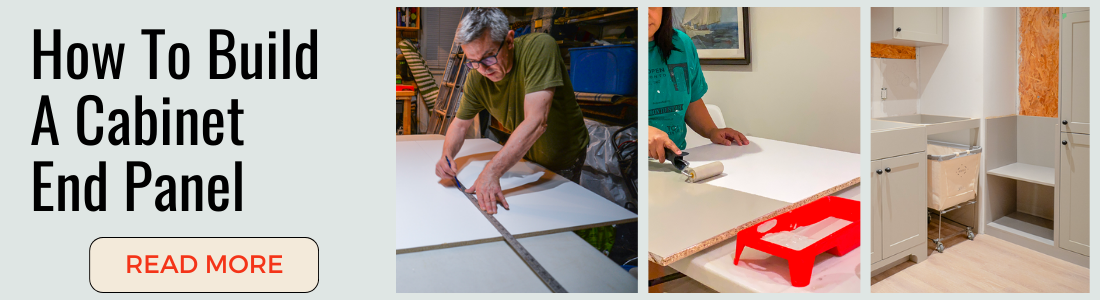
DIY Cabinet Gable or End Panel:
UPDATE: In the new laundry room in our new home, we followed this
same method to support the countertop but we made our own gables/end
panels this time and finished them to match the cabinetry.
See this post for tips on building DIY gables/cabinet end panels.
How to Build a Plywood Countertop (Countertop Substrate):
Building a countertop substrate is basically the same as building a
plywood countertop. Once its built, you can keep your plywood
countertop as is or finish it off with various surface materials
such as
laminate sheeting,
veneer edge banding, paint, or stainless steel. Here is how you can build that plywood
substrate.
What you are looking at is the underside of the countertop. This
countertop is built out of a sheet of 3/4" plywood with additional
3/4"strips around the perimeter and middle. The middle strip is what
the centre gable will screw upwards into.

4. Affix the countertop to the cleats and gable
Use a combination of L-brackets, construction adhesive, and screws to affix the countertop and gable. This task is best done with two people.- First, if you have a side gable, put it in place. If it is beside a cabinet, attach it to the cabinet with cabinet screws from inside the cabinet.
- Put your countertop in place resting it on the cleat and side gable. Have one person hold the countertop while the other person attaches L-brackets around the perimeter of the countertop. Screw one side of the L into the countertop and the other into the cleat.
- Slide the centre gable in place. Use L-brackets along the top of the gable with one side screwed into the underside of the countertop (along the middle horizontal piece) and the other into the gable.
Once the wood countertop has been attached to the cleat and gables, slide the washer and dryer back in place. Here's our plywood countertops installed!


You might be wondering where our water shut-off valves are. We've
brought them into the hidden storage room that sits behind this
laundry room. See the washing machine supply lines in
this post.
If we had sanded and sealed the plywood, we could call this project
done and just use it as a DIY plywood countertop over the washer and
dryer. However, while a plywood countertop is affordable it's not
exactly the most durable or water resistant for use in a laundry
room.
Instead, we took that plywood substrate to a metal fabricator and had
it clad with stainless steel.


Stainless Steel Countertop
The more we thought about it, the more stainless steel countertops in
the laundry room made sense. They are resistant to water and heat
damage, hygienic, and would create a nice integrated look with the
stainless steel sink. Plus, they are reflective and nicely bounce the
light around this windowless laundry room.
Stainless steel can be expensive but we called around and found a
local fabricator with an amazing price and very quick turnaround.
Because we built the substrate ourselves and did the install too, we
saved on the cost.

We've already done tons of loads of laundry and I have to say it feels great to fold clothes and have this counter over the washer and dryer. There is enough space between the counter and the upper cabinets. This is quickly becoming one of our favourite rooms in the house :)
There's more to come in this room, but we'll leave those surprises for
another post.
***
UPDATE: We used the cleat & gable method once again for the
countertop in
our latest laundry room. However, this time, instead of using a pre-made panel as a gable,
we made our own gable.
See this post for more information about how to build a DIY cabinet end
panel. There's tips on selecting materials for an end panel, scribing
your panel to the floor, and how to finish your panel to match your
kitchen cabinetry.
See this post for a glimpse at our latest
DIY basement laundry room renovation.
****
Looking for other Laundry Room projects? Check out:
 How to build DIY cabinet end panels |
 How to make cabinets look built in |
 Laundry Room Renovation Tips |
 Backsplash Tile Installation Tips |


